
How redeveloping a 42-year-old water well restored and improved its performance.
Declining well production often raises an expensive question: is it time to drill a new well?
That was the situation at the Fraser Valley Trout Hatchery in Abbotsford, BC. Installed in 1980, Well #4 had supported the hatchery for more than four decades, but records showed a steady decline in performance.
Before committing to a replacement, the owner asked the question that should always come first: could the existing well be restored through redevelopment?
In August 2022, Precision Service & Pumps Inc. was brought in to do the work and determine the best path forward.
Understanding the Problem
Well #4 had not failed overnight. Its production had declined gradually over decades.
Mineral deposits, sediment accumulation, and changing aquifer conditions had reduced efficiency and placed increasing pressure on the hatchery's operations.
The key question was whether the well had reached the end of its useful life, or whether development could bring it back.
A Complete Well Assessment
Precision Service & Pumps Inc. removed the pumping equipment, completed a downhole video inspection, and performed a flow test to establish the well's current condition and performance, and to identify the opportunities for improvement.
Historical records dating to the original installation allowed Precision Service & Pumps Inc. to compare current results with more than 40 years of data and set a clear redevelopment benchmark. Comparing specific capacity at the same flow rates can help quantify improvement.
The findings confirmed that the well remained a strong candidate for redevelopment.
Redevelopment in Action
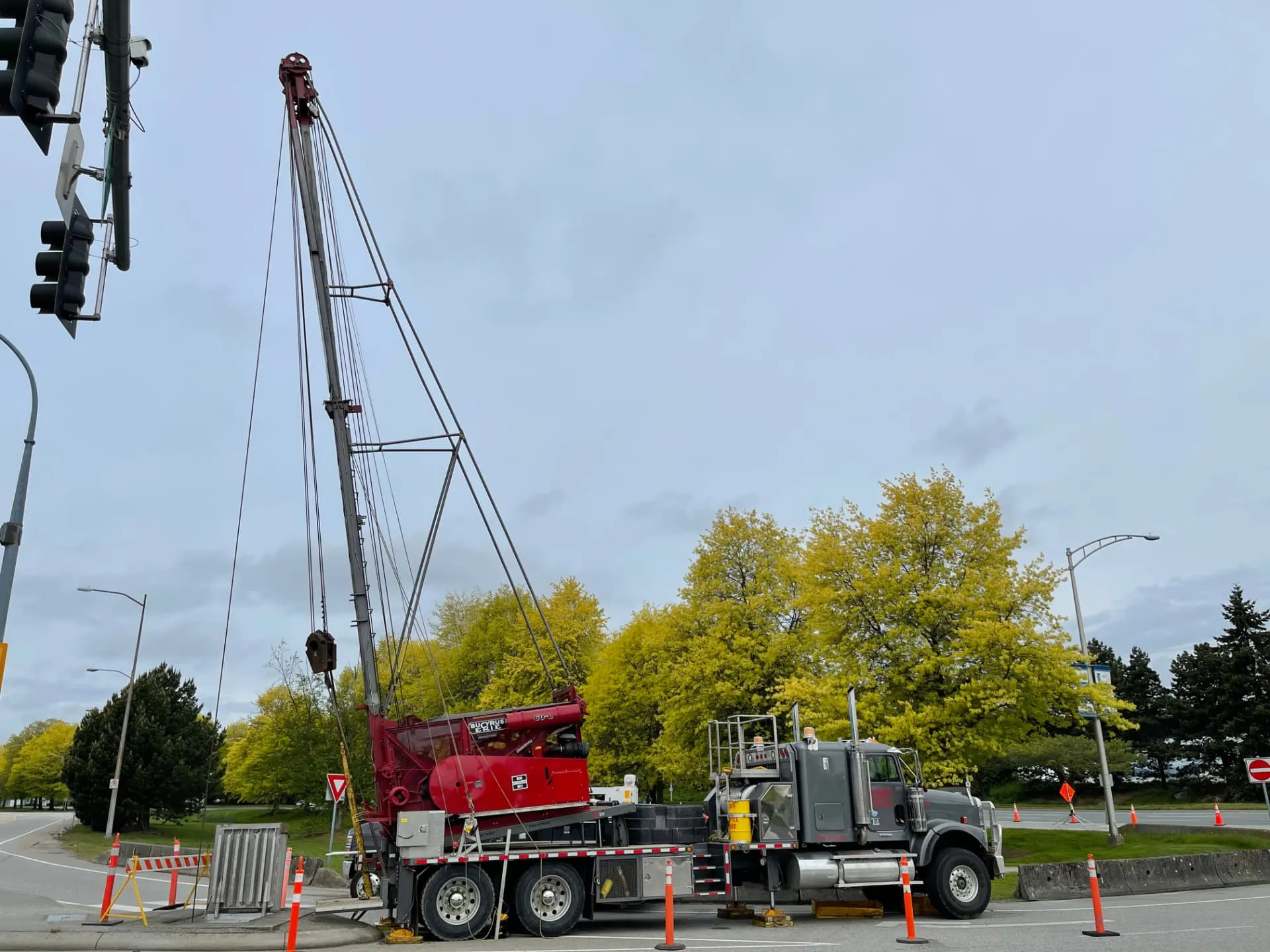
Precision Service & Pumps Inc. mobilized our larger BE60L cable tool rig and carried out a structured redevelopment program to improve groundwater flow into the well.
The program included:
- Surge block redevelopment with simultaneous pumping
- Bailing to remove accumulated fines
- Chemical treatment and continued surging
- Pumping to waste
- Downhole video inspection
- Reinstallation of pumping equipment
- Flow test to confirm performance improvement
Precision Service & Pumps Inc. combined mechanical and chemical methods to remove accumulated deposits and improve the hydraulic connection between the aquifer and the well. Surging moves water back and forth through the screens, loosening and drawing fines from the surrounding formation into the well. Where feasible, simultaneous high-rate pumping continuously removes loosened material. Bailing removes accumulated fines and provides a measurable indication of material recovery and progress toward completion.
The Results
Post-redevelopment testing showed that Well #4 recovered lost capacity, bringing its performance close to the original benchmark recorded when the well was new.
Production and efficiency improved, confirming that the existing well still had substantial value and remaining service life.
The hatchery could continue using its existing infrastructure and maintain its water supply without immediately drilling a replacement well.
The project deferred a major capital expense and provided reliable data for future planning.
Power consumption also decreased because pumping could take place at a higher water level.
What Redevelopment Costs Against a New Well
In our experience, redevelopment typically costs 10 to 20 percent of a replacement well while restoring capacity and extending asset life.
The larger saving is often not the drilling. For most owners the greatest cost of replacement is time: studies, permitting, approvals, testing, construction, and commissioning. Redevelopment can usually be completed in weeks rather than the years required to develop a new water source, which reduces capital risk and schedule risk together.
Why This Project Matters
Water systems operated by municipalities, industrial partners, and government entities across British Columbia and into the Yukon rely on aging wells.
Declining production does not automatically mean those assets need to be replaced.
Before committing to a new well, first determine whether redevelopment can restore the existing one. New wells also require development before entering production, so assessing the existing asset can be a practical first step.
Contamination, infrastructure changes, or historical data showing no improvement may instead support considering a new well first.
Assessment and redevelopment can reduce risk, recover capacity, and extend service life before an owner commits to costly new construction.
Key Takeaway for Operators
Before budgeting for a replacement well, ask: has the existing well been properly assessed and redeveloped?
Video inspection, performance testing, and redevelopment analysis can reveal whether lost capacity is recoverable.
For Well #4, that process restored production, improved efficiency, and raised performance close to the well's original benchmark.
Sometimes the best well to develop is the one you already have.
Need Help Evaluating an Aging Well?
Precision Service & Pumps Inc. provides well and pump inspections, flow testing, development, and rehabilitation services for communities, industrial partners, and government entities across British Columbia and the Yukon.
If your well is not producing as it once did, let's find out why before you drill a new one.